




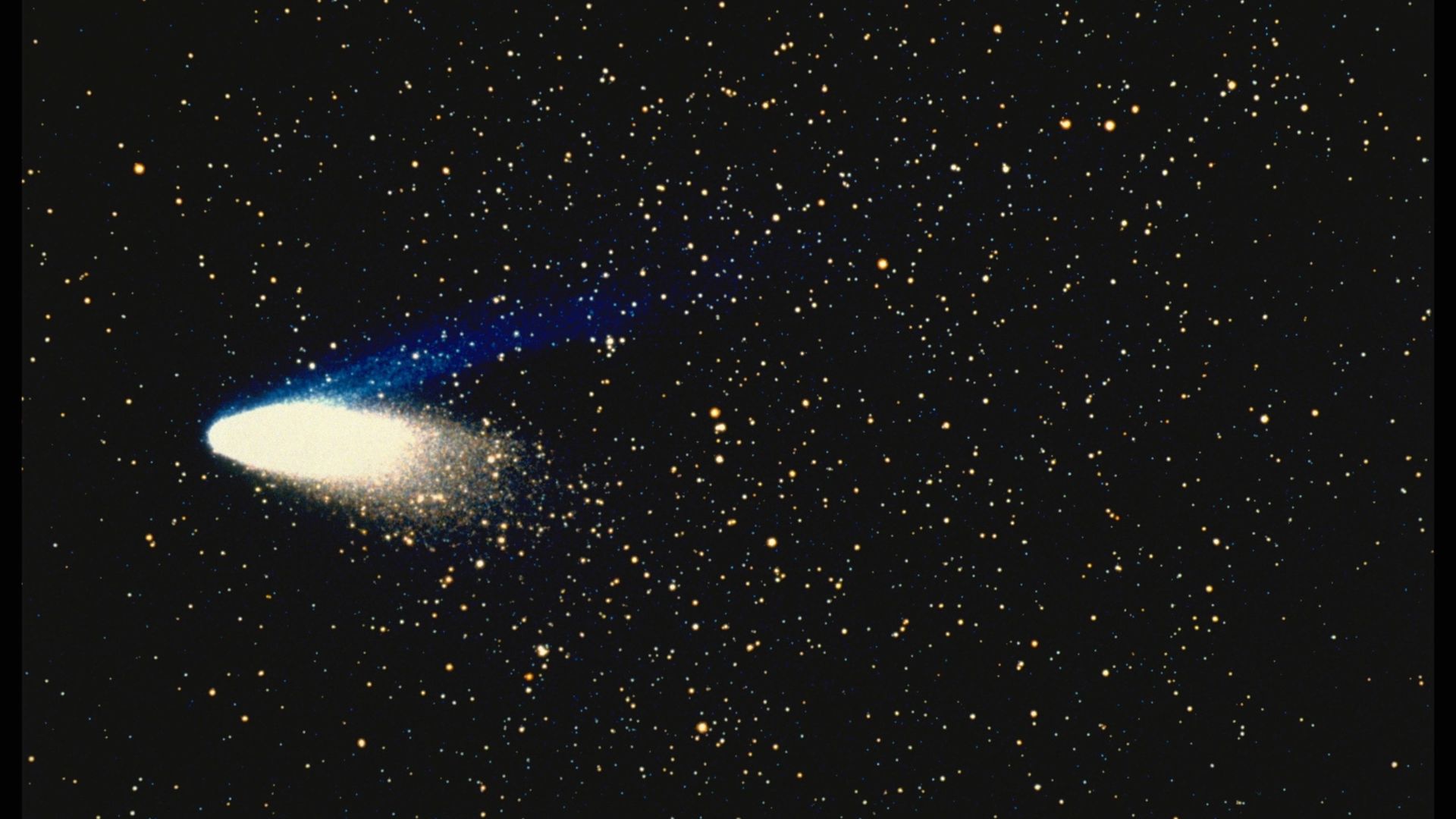
This year, 2026, marks the 40th anniversary of the most recent appearance of Halley’s Comet, the most famous comet in the solar system.
Roughly every 76 years, Halley punctuates history like an exclamation mark in the night sky. As writer Guy Ottewell has said, it is the “wildest of the tame comets.”
It is a tame comet because it can be anticipated. It is wild because it is still fresh and bright; the brightest of all the recurring comets. It is the only one that periodically becomes conspicuous to the naked eye.
Halley through history
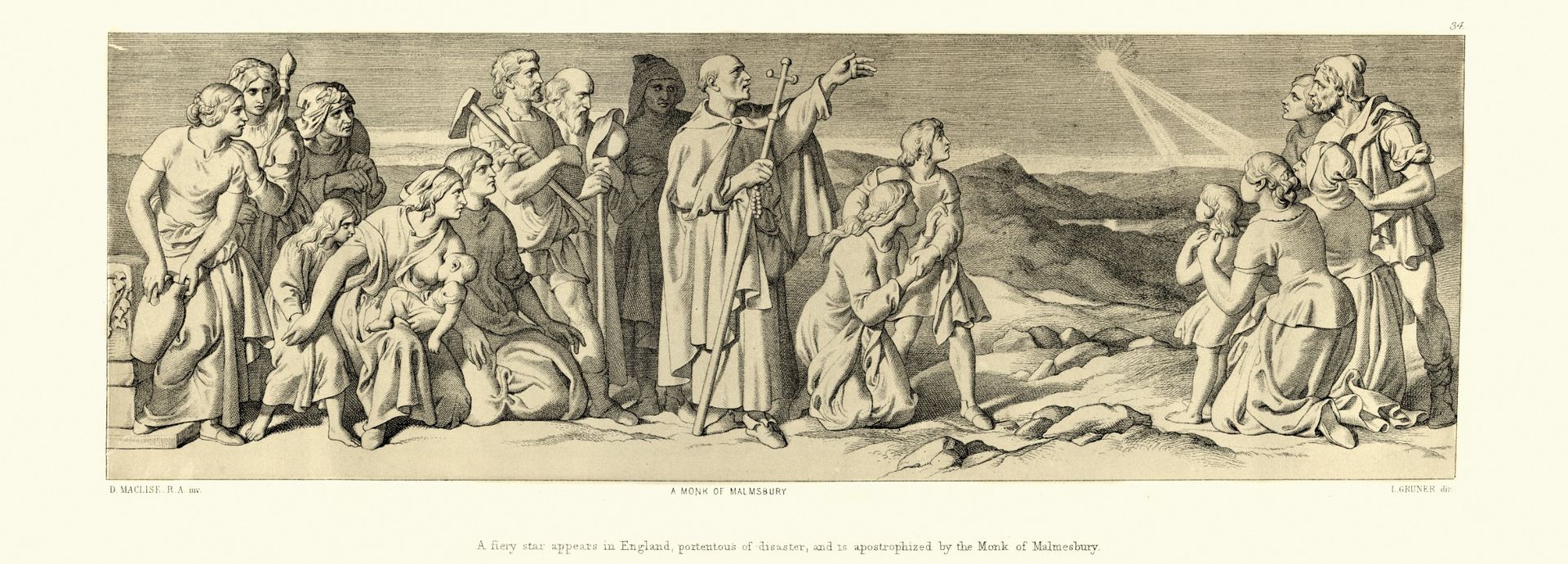
Before 1986, Halley had been seen and recorded on 29 occasions. In A.D. 66, observers described it as a sword in the skies above Jerusalem. In 1066, its image was woven into the strip of linen now known as the Bayeux Tapestry, where an agitated crowd of Saxons points toward a fiery comet we know to be Halley. In 1301, the Florentine painter Giotto di Bondone witnessed the comet and was so impressed that, a few years later, he depicted a comet as the star that led the Magi to Bethlehem in one of his magnificent frescoes in Padua’s Scrovegni Chapel.
More recently, Halley passed unusually close to Earth in 1910. As the 1986 return approached, people who remembered that earlier appearance likely told their children and grandchildren about being awakened before dawn and taken outside to see a huge, ghostly, gleaming object in the sky.
Halley’s earlier appearances suggested that each return to the inner solar system might produce a magnificent display. Little wonder, then, that the public expected great things in 1986.
The great disappointment of 1986
Halley’s 1986 return therefore became two very different stories: a frustrating spectacle for much of the public and an unprecedented scientific opportunity for astronomers.
But for many who saw it — or tried to — in 1986, Halley is remembered as a tremendous disappointment. Heavily promoted as the most anticipated celestial event of the second half of the 20th century, the comet proved to be an underwhelming sight that belied promises of a spectacle never to be seen again.
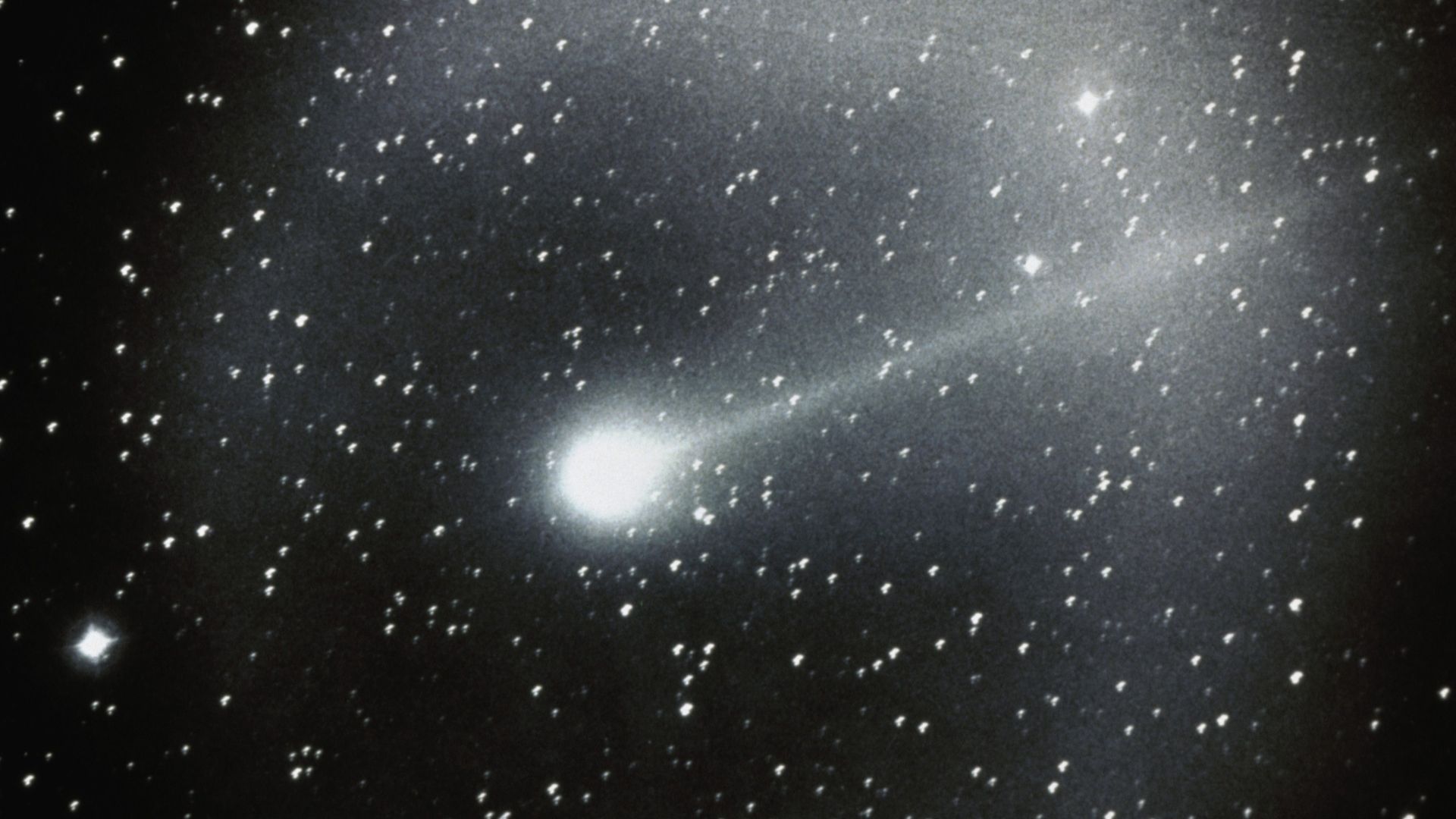
In all fairness, Halley’s subpar performance was not unexpected. During the mid-1970’s, comet experts had warned that the comet would likely disappoint much of the general public. Despite that, the comet’s impending arrival was accompanied by a frenzy of T-shirts, commemorative comet medals, bumper stickers, and specially marketed telescopes. Halley logos could be found on warm-up jackets, cocktail glasses, cereal boxes, and just about everything in sight. Caught up in the grip of Halley-mania, the mainstream media emphasized that the comet would be a “once-in-a-lifetime spectacle.”
One of the main problems for many trying to see the comet that year was light pollution; the total outdoor illumination in the United States had increased tremendously since Halley’s previous visit in 1910. Indeed, in 1986, many of the largest cities were bathed in permanent twilight, with only the brightest stars and planets visible from near city centers and with astronomically unacceptable conditions up to 50 miles (80 km) away.
On the evening of Jan. 11, in New York City, thousands gathered at four city parks to get a view of Halley’s Comet. Mayor Ed Koch and Parks Commissioner Henry J. Stern arranged to have the lights turned off at four public parks, where telescopes were set up. The comet itself was not overly impressive, but many were still happy just to get a glimpse of it. As Stern put it: “Those who came for the comet saw the comet — the cynics didn’t — but it was there.”
When Halley passed through perihelion — its closest point to the sun — on Feb. 9, it lay on the far side of the sun as viewed from Earth and was hidden in the solar glare. During much of March, it brightened only to third magnitude and displayed a tail about a dozen degrees long, merely one-tenth the extent of its 1910 splendor. At the same time, it moved southward through the stars of Sagittarius, Scorpius, and Centaurus. Because those constellations appear low above the southern horizon, the comet was difficult to see from Canada, Europe, and the northern United States.
The 1986 apparition was, in fact, described as the comet’s worst in 2,000 years. And as one would expect, the public wasn’t impressed. Having read that he’d need binoculars and a star map just to find the comet, taxi driver David A. Gittelman penned a New York Times opinion piece entitled “Who Cares About Halley’s Comet Anyway?” In it he wrote:
“I was devastated. How could such an injustice be allowed to prevail? All my life I’d been waiting — all my life. What happened to the cosmic leviathan of my childhood dreams?”
What happened was that at its closest approach to Earth on April 10, Halley was nearly three times farther away than at its minimum distance in 1910. And it had arrived at this point a full two months after perihelion (instead of two weeks as in 1910) — long after its brightest phase had passed. Even those living or traveling to the Southern Hemisphere (as I did), where the comet was well placed, didn’t witness a true showstopper. To make matters worse, Halley’s tail suddenly ebbed at the beginning of April, leaving behind a small, condensed, nebulous mass with a stubby, fan-shaped appendage.
The leviathan turned out to be a mere tadpole!
A scientific gold mine
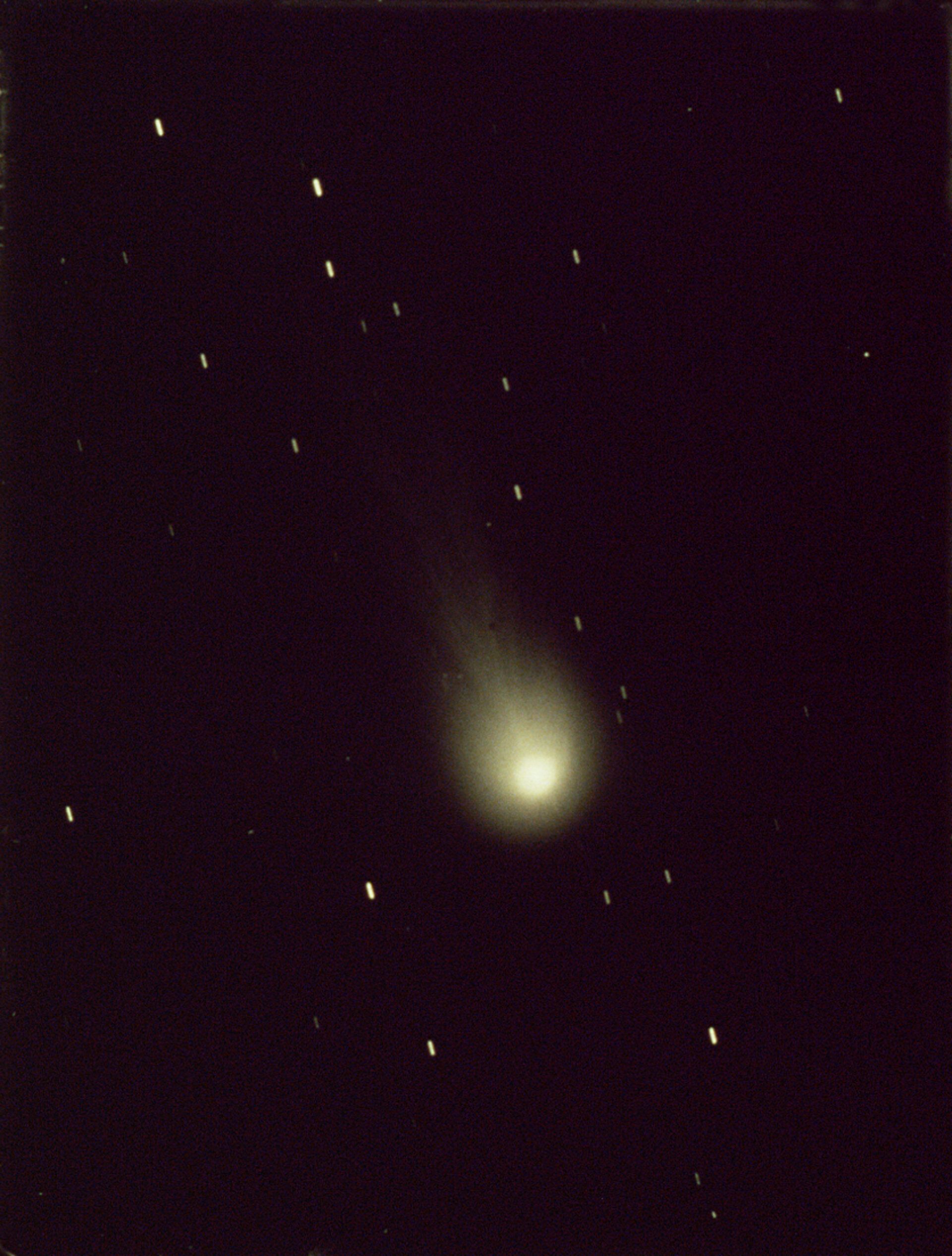
But while Halley disappointed the public, it proved to be an astronomical gold mine for astronomers. Within three weeks in March 1986, an international armada of spacecraft studied the comet: Japan launched Sakigake and Suisei; the Soviet Union sent VEGA 1 and VEGA 2; NASA contributed the International Cometary Explorer (ICE); and the European Space Agency, then a consortium of 11 countries, launched Giotto.
VEGA 1 and 2 and Giotto plunged deep into Halley’s coma — the fuzzy, glowing cloud of gas and dust that surrounds the nucleus when it travels close to the sun — and revealed it to be an active, sputtering mass that responds violently to heating by the sun. Jets of dust were expelled from the nucleus with explosive intensity. And we discovered that the nucleus is encrusted in a dark shroud of its own debris and is as black as coal or velvet. Each VEGA spacecraft came to within about 5,300 miles (8,500 km) of Halley.
Giotto passed within just 375 miles (600 km) of the nucleus. More than 2,000 returned images showed that Halley’s nucleus was larger than expected and shaped like a peanut or potato, measuring 9 miles (14 km) long and 5 miles (8 km) wide. The nucleus spins on its longest axis every 7.4 days, while the entire body appears to wobble in half that time. The images also revealed three “active regions,” areas where volatile gases and dust escape when sunlight heats the surface. As the comet rotates, fresh ice enters the sunlight and sublimates; the escaping gas then drags entrained dust particles away from the nucleus.
VEGA 1 and 2 and Giotto plunged deep into Halley’s coma — the fuzzy, glowing cloud of gas and dust that surrounds the nucleus when it travels close to the sun — and revealed it to be an active, sputtering mass that responds violently to heating by the sun. Jets of dust were expelled from the nucleus with explosive intensity. And we discovered that the nucleus is encrusted in a dark shroud of its own debris and is as black as coal or velvet. Each VEGA spacecraft came to within about 5,300 miles (8,500 km) of Halley.
Giotto passed within just 375 miles (600 km) of the nucleus. More than 2,000 returned images showed that Halley’s nucleus was larger than expected and shaped like a peanut or potato, measuring 9 miles (14 km) long and 5 miles (8 km) wide. The nucleus spins on its longest axis every 7.4 days, while the entire body appears to wobble in half that time. The images also revealed three “active regions,” areas where volatile gases and dust escape when sunlight heats the surface. As the comet rotates, fresh ice enters the sunlight and sublimates; the escaping gas then drags entrained dust particles away from the nucleus.

So, from this tiny, jet-black, dust-encrusted nucleus came all the ingredients necessary to form the bright comet head and tail that branded it as a historically magnificent and awe-inspiring spectacle.
The spacecraft encounters transformed a disappointing naked-eye apparition into a landmark scientific campaign. Yet Halley’s story did not end when the probes passed through its coma.
Surprises beyond 1986
Long after 1986, a receding Halley’s Comet showed that it could still provide some surprises. On Feb. 12, 1991, between the orbits of Saturn and Uranus at 1.329 billion miles (2.138 billion km) from the sun, Halley was photographed from the European Southern Observatory in Chile by two Belgian astronomers. They had expected to find the comet appearing as nothing more than a faint speck of light. Instead, it appeared as a monstrous nebula 300 times brighter than expected; a massive outburst.
The cause of the dramatic flare-up remains a mystery. An unknown body may have collided with the comet. Another possibility is that the nucleus released a large amount of latent internal energy, although such a release would be unlikely so far from the sun. Highly energetic particles in the solar wind may also have reached the comet in sufficient numbers to heat its surface.
The road to 2061
On Dec. 8, 2023, Halley’s Comet reached aphelion; the farthest point in its orbit from the sun.
Halley is expected to return in the summer of 2061, in circumstances that will largely mirror those of 1986 — but with one crucial difference. This time the comet will be fully visible on the same side of the sun as Earth and should appear at least 10 times brighter. In the morning sky, it will reach its northernmost position on July 24. It will then move rapidly southward as it enters the evening sky, gradually favoring more southerly locations. Even so, viewers at mid-northern latitudes should see an eye-catching object low in the west-northwest sky in early August.
And we don’t have to wait until 2061 to experience Halley.
Like all comets, Halley’s is a cosmic litterbug and, as such, it leaves behind in its wake a trail of — for lack of a better term — garbage, composed of tiny bits and crumbs of space debris that can produce beautiful incandescent trails upon impacting our atmosphere. Because they emanate from the constellation Orion, we call them the Orionid meteors, which will reach their peak on Oct. 21.
In a way, I guess you can call them “rock stars,” but eventually, they fall down to Earth.
Joe Rao serves as an instructor and guest lecturer at New York’s Hayden Planetarium. He writes about astronomy for Natural History magazine, Sky and Telescope, The Old Farmer’s Almanac and other publications.
Source: Space.com